

Stop Arguing Your Case. Start Holding the Question
A mid-level leader's guide to communication that actually moves organizations


This is Empathy Elevated - your weekly guide and shortcut to mastering emotional intelligence through the power of empathy. Last week, I wrote You Were Never Just the Task
Emotional Intelligence • Stoicism • Human–AI Partnership
Practical frameworks for clearer communication, better judgment, and less friction in modern work.
Today’s guest post comes from Craig Mattson
Craig is the writer behind The Mode/Switch, a newsletter and podcast for mid-level leaders navigating the pressure of managing both up and down. He’s the author of three books, including his most recent, Digital Overwhelm: A Mid-Career Guide to Coping at Work, and holds a Ph.D. in Communication (Rhetoric) from Regent University. He currently serves as the Arthur H. DeKruyter Chair in Faith & Communication at Calvin University, where he teaches in the Master’s of Media & Strategic Communication program.
Craig’s work centers on what he calls “mode/switches” — small, language-driven shifts that help leaders build resonance and reliability with their teams. You can find more of his writing at themodeswitch.substack.com.


Rachel Hennessy has done marketing and communication in almost every conceivable organizational space, from corporate to nonprofit to startups and tech. During our interviews, her brain never stopped churning out fresh, sometimes funny, always fascinating ways of thinking about organizational community.
But because her brain’s so fast, other people can have a hard time keeping up with her.
She told me a story about dreaming up a webinar series idea for her company. It was timely, fitting, and on brand. So she pitched the idea to her CEO—and got precisely nowhere. Then one day, a year later, seemingly out of nowhere, he said, “Hey, what if we do a series of webinars?”

What happened? Was her boss simply appropriating a woman professional’s brainstorm? Had Rachel found just the right killer argument, landing on the exact data point her boss would care about?
To understand what made her communication eventually effective, let’s switch its direction.
Let’s say that senior leadership suddenly buys the rights to a new platform for the company. All the managers get an email blurbing, “Hey, team, we’re rolling out AI agents that you can use for expense reports! Let your people know ASAP!” Here, suddenly, managers have to do a lot of communicative work directed not upwards but outwards to the front-line workers. Given the realities of “AI fatigue,” a mid-level leader can expect to talk to cranky teams with more tools than time.
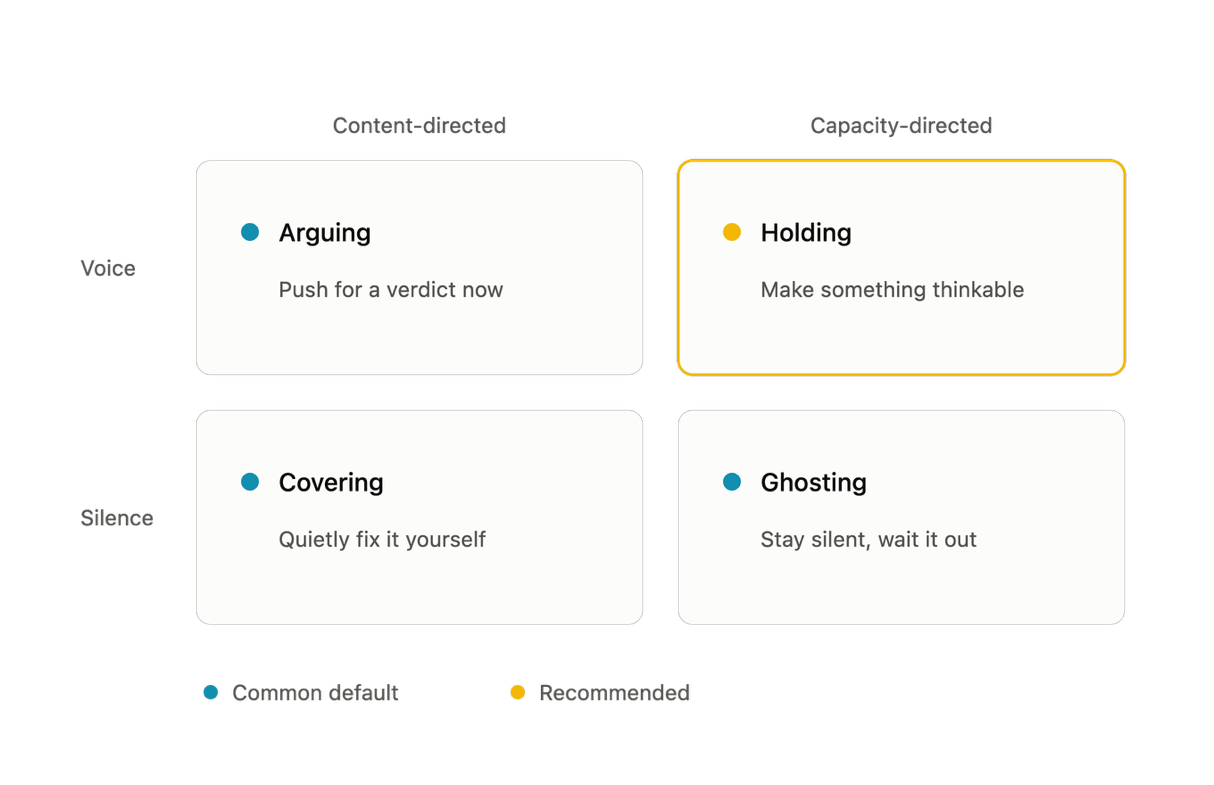
Whether advocating up or out, the communication’s difficult. It’s so difficult, in fact, that the mid-level leader can be forgiven for resorting to reductive measures (akin to talking ever louder to a non-native speaker). You might feel the temptation to argue, ghost, or cover. I’m going to suggest a fourth way instead. I call it holding.
Arguing
“I know you guys dread adopting yet another new platform. But, look, the data’s clear: this platform could increase our productivity by 44%.”
That kind of proposition makes a lot of sense to people like me who assume, with the right evidence-based argumentation, people will swing on board.
But you probably have enough experience in the middle of organizations to spot this assumption’s problem: people often don’t behave like rational actors. You can craft your emails and design your decks, infusing them with winsome graphics and amusing anecdotes. But trying to argue your way to change isn’t likely to work.

Ghosting
Team member: “I heard the boss is all excited about a new AI platform. Is that true?”
You: [stares vacantly out the window]
Another approach to organizational persuasion is to give up on communication altogether. When the senior leadership wants you to cascade a new idea to the team, you could ignore the request, hiding behind a screen of overwork. Or you could forward the email to the team without comment.
Either way, you’re ghosting. You’re attempting organizational invisibility.
The problem with this approach is that its posture of avoidance makes you feel cornered. Eventually, your boss is going to ask why nobody’s using the new agents. Eventually, your workers will buttonhole you on Teams about the email you forwarded.
Ghosting eventually takes you right back into Arguing mode.
Covering
“Let me do that for you.”
If you’re a thoughtful and kindly soul, you may be tempted to resolve the difficulty by fixing other people’s difficulties quietly. This happens in at least one of two ways. One way is to play chameleon, being whoever you need to be for the immediate audience: reassuring the boss behind closed office doors; placating the team in the break room. A second way is to absorb other people’s work (e.g., taking tasks off your team’s plate). Perhaps if you lighten their load, they’ll be more open to new ideas.
This minimalist approach may arise from tactful and even noble intentions. It’s a species of naïve optimism that a colleague of mine likes to call “hopium.” You can smoke it, but it’s not likely to alter a problematic situation for the better.

Holding
Here’s my recommendation: switch from content-driven to capacity-focused communication. Instead of thinking of what you want your communication to say, think about what capacity your communication can make possible. This entails a change in persuasive priorities. Instead of urging a particular verdict (from senior-level judges or front-line jury members), you’re helping others hold a complex question anew. In contrast with the other options above, Holding keeps the tension visible, instead of forcing a verdict like Arguing or effacing the tension like Ghosting and Covering.
How can you do this? What specific behaviors tend to make this possible in the pressured middle spaces of organizations? I offer three areas to try out new communicative moves:
Words: Changing the questions you ask may be the most powerful explicit move you make. Some of the best mid-level leaders I know ask questions all the time: “What else is true here?” “What would need to be true for this to happen?” “I think I can hear your frustration. What else might be at play in this disagreement?” “Yes, this does sound difficult, and it might make more margin for us to do stuff we care about.”
Manner: It’s stunning what a well-placed pause can do, especially if it’s joined with a smile and a slight lifting of the shoulders. I used to work with a mid-level manager who knew how to nod at what people were saying in a way that signaled neither acceptance nor rejection but acknowledgment and consideration.
Timing: Sometimes the game of organizational communication is all about pacing and inception. Try mentioning something, seemingly in passing, but in a way that plants a latent idea, one that might feel like the person’s own idea later. Or try asking, “How about if we revisit this in a few weeks?” Such a question keeps the current emotional climate from dominating a decision.
A final thought
For Rachel, achieving a new good idea took about a year of rather oblique hinting. Your company might not have that long. The good news is that this newsletter’s argument isn’t about speeding up or slowing down. Nor is it about directness or indirectness. I’m not just echoing the Elaboration Likelihood Model by explaining that unmotivated people won’t engage a highly rational “central route” of persuasion. So, you know, avoid those 800-word, heavily hyperlinked explanatory emails.
What I am suggesting involves a step before either communicative speeds or angles of approach. It’s not about getting acceptance or rejection. It’s more a matter of communicating in a way that acknowledges a tension and holds a question.
That’s what Rachel achieved with her CEO. Pull a parallel set of moves, and you can achieve the same with your team.
 | A guest post by
|
Honored to partner with you, Colette, and to connect with your Empathy Elevated listeners. I can vouch from the outside-in that this is a newsletter worth subscribing to, especially if you're wondering about being emotionally wise while engaging systems and teams.
This is an important distinction.
Good communication is not always about finding a stronger argument. Sometimes the real work is creating enough space for people to examine the tension without feeling forced into an immediate position.
When people feel that a conclusion is being pushed on them, they defend themselves. When they feel that the question is being held with them, they are more likely to think.